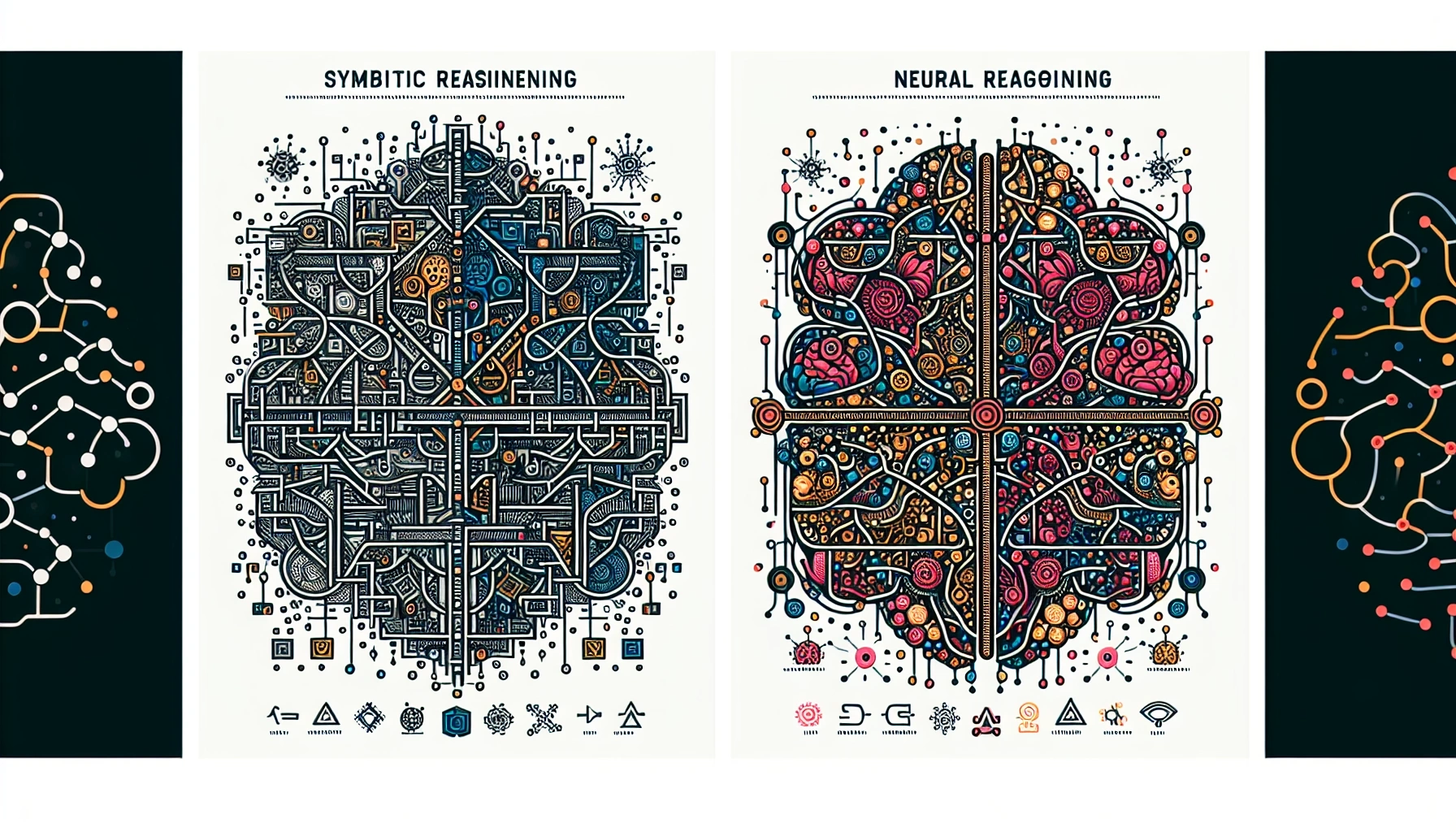
Symbolic Reasoning AI: How It Works
Symbolic reasoning AI (often called “GOFAI,” logic-based AI, or knowledge-based AI) represents the world using explicit symbols—facts, rules, ontologies, and logical relationships. Instead of learning patterns purely from data, it manipulates structured knowledge such as IF–THEN rules, predicate logic, knowledge graphs, and constraint systems. The core idea is that intelligence can be achieved through formal reasoning: given a set of premises, the system derives valid conclusions via inference.
Common symbolic components include:
- Knowledge representation: rules, frames, semantic networks, and ontologies (e.g., OWL/RDF).
- Inference engines: forward chaining, backward chaining, resolution, and SAT/SMT solving.
- Planning and constraints: classical planning (STRIPS/PDDL), constraint satisfaction (CSP), and optimization.
Because knowledge is explicitly encoded, symbolic AI can provide clear explanations (“this output occurred because rules A and B fired”) and often supports strong guarantees about correctness under specified assumptions.
Neural Reasoning AI: How It Works
Neural reasoning AI uses neural networks—especially deep learning and transformer models—to approximate reasoning through learned representations. It typically learns from large datasets, discovering patterns that correlate inputs with desired outputs. Rather than operating on explicit rules, neural models encode information in distributed vectors (embeddings) and use attention, sequence modeling, and learned parameters to generalize across examples.
Neural reasoning appears in tasks like:
- Natural language inference (NLI): entailment, contradiction, and neutrality.
- Multi-step question answering: chaining facts across passages.
- Tool-augmented reasoning: retrieving documents, calling APIs, and executing code.
- Program synthesis and structured prediction: generating SQL, regex, or workflows from text.
Modern approaches often mix neural methods with external memory (retrieval), tools, or structured constraints to improve reliability and factuality.
Key Differences Between Symbolic and Neural Reasoning AI
1) Representation: Explicit Rules vs Distributed Embeddings
- Symbolic AI: Knowledge is explicit, human-readable, and discrete (e.g., “All invoices over $10,000 require approval”).
- Neural AI: Knowledge is implicit in weights and embeddings (e.g., a transformer “knows” patterns from training but cannot easily list rules).
SEO-relevant takeaway: Symbolic reasoning excels at rule-based decisioning; neural reasoning excels at pattern recognition and language understanding.
2) Learning Method: Knowledge Engineering vs Data-Driven Training
- Symbolic: Often requires domain experts to craft rules, ontologies, and constraints. Updates can be as simple as editing a rule.
- Neural: Requires curated datasets, compute, and training pipelines. Updates may require fine-tuning, retraining, or retrieval augmentation.
3) Generalization: Compositional Logic vs Statistical Similarity
- Symbolic: Strong at compositionality when rules cover the domain; weak when encountering unmodeled cases.
- Neural: Strong at handling messy, ambiguous inputs; may generalize via similarity but can fail on edge-case logic or distribution shifts.
4) Explainability and Auditing
- Symbolic: Highly interpretable; supports traceable inference chains. Helpful for compliance, safety, and debugging.
- Neural: Explanations are often post-hoc; attention maps and feature attribution may not satisfy strict audit needs.
5) Robustness and Guarantees
- Symbolic: Can provide formal guarantees (e.g., constraint satisfaction, consistency checking).
- Neural: Probabilistic outputs; may hallucinate, overfit, or behave unpredictably without guardrails.
6) Handling Uncertainty
- Symbolic: Classical logic is brittle under uncertainty; extensions like probabilistic logic, Bayesian networks, and fuzzy logic help.
- Neural: Naturally supports uncertainty through probabilistic modeling and soft decisions, but calibration may be imperfect.
7) Scalability and Maintenance
- Symbolic: Rule sets can become complex (“rule explosion”), and maintaining consistency is challenging at scale.
- Neural: Training scales well with data and compute; maintenance focuses on datasets, monitoring drift, and evaluation.
Use Cases Where Symbolic Reasoning AI Excels
Rule-Based Compliance and Policy Enforcement
Industries with strict policies—finance, insurance, healthcare, and government—often prefer symbolic systems for deterministic enforcement.
Example: A loan underwriting engine applies transparent eligibility rules, flags missing documents, and logs which policy triggered a denial.
Configuration, Scheduling, and Optimization
Symbolic approaches like CSP and SAT/SMT solvers excel at combinatorial problems.
Example: Airline crew scheduling can be framed as constraints (rest time, qualifications, routes) and solved with optimization.
Knowledge Graph Reasoning and Ontologies
When relationships matter and explainability is critical, symbolic reasoning over a knowledge graph is powerful.
Example: In cybersecurity, linking indicators of compromise (IOCs) to tactics, techniques, and procedures (TTPs) enables rule-driven threat detection.
Formal Verification and Safety-Critical Systems
Symbolic logic supports proofs and verification.
Example: Verifying that a medical device controller never enters an unsafe state under specified conditions.
Use Cases Where Neural Reasoning AI Excels
Natural Language Understanding at Scale
Neural models handle ambiguous language, paraphrases, and unstructured text better than purely symbolic methods.
Example: A customer support assistant interprets varied user phrasing, routes tickets, and drafts responses.
Perception-Heavy Reasoning: Vision, Audio, and Multimodal Inputs
Symbolic systems struggle with raw pixels or audio waves; neural networks thrive here.
Example: An autonomous inspection system detects defects in manufacturing images and reasons about severity from visual cues.
Open-Domain Question Answering and Retrieval-Augmented Reasoning
Transformers combined with search can answer questions across large corpora.
Example: A legal research tool retrieves relevant case law passages and generates an argument outline based on the citations.
Pattern Discovery and Anomaly Detection
Neural models can detect subtle patterns that are hard to encode as rules.
Example: Fraud detection models learn behavioral patterns across transactions, devices, and timing signals.
Concrete Examples: Symbolic vs Neural Approaches to the Same Problem
Example 1: Medical Triage
- Symbolic: Encodes clinical guidelines (“chest pain + shortness of breath → emergency referral”). Pros: auditable; Cons: limited to encoded rules.
- Neural: Learns from historical triage outcomes and notes. Pros: adapts to varied language; Cons: needs careful validation to avoid unsafe recommendations.
Example 2: Tax Classification
- Symbolic: Maps transaction types to tax codes with explicit jurisdiction rules. Pros: compliance-ready; Cons: complex upkeep across regions.
- Neural: Classifies expense descriptions using embeddings. Pros: handles messy descriptions; Cons: may misclassify rare categories without sufficient data.
Example 3: Enterprise Search and Answers
- Symbolic: Uses ontologies and metadata filters (“HR policy documents updated after 2024”). Pros: precise; Cons: relies on curated tags.
- Neural: Semantic search retrieves conceptually similar documents even without keyword overlap. Pros: strong recall; Cons: may retrieve plausible but irrelevant results without re-ranking.
Hybrid Neuro-Symbolic AI: Practical Combinations
Many real-world systems combine both paradigms to get the best of each:
- Neural for understanding, symbolic for decisioning: Use an LLM to parse a user request, then apply a rules engine for final eligibility decisions.
- Symbolic constraints over neural outputs: Generate candidate plans with a neural model, validate with constraints (safety rules, budgets, permissions).
- Knowledge graphs + embeddings: Use embeddings for retrieval, then symbolic reasoning for relationship consistency and explainable paths.
Example hybrid workflow: An insurance claims assistant extracts entities from text (neural NER), matches them to a knowledge graph of policy terms (symbolic), then applies deductible and coverage rules (symbolic) while generating a customer-facing explanation (neural).
Evaluation Criteria: Choosing the Right Reasoning Approach
When selecting symbolic reasoning AI vs neural reasoning AI, decision-makers typically assess:
- Explainability requirements: Do you need a traceable chain of logic for audits?
- Data availability: Do you have labeled examples, or mostly expert knowledge and policies?
- Error tolerance: Are mistakes costly or safety-critical?
- Domain volatility: Do rules change frequently (favor symbolic edits) or does language/input drift frequently (favor neural adaptability)?
- Integration needs: Must the system work with databases, workflows, and policy engines?
Common Pitfalls and Limitations
Symbolic AI Pitfalls
- Knowledge engineering bottlenecks and slow initial development.
- Fragility when encountering unmodeled exceptions.
- Rule interactions causing unexpected outcomes without careful testing.
Neural AI Pitfalls
- Hallucinations and weak factual grounding without retrieval or constraints.
- Dataset bias leading to unfair or noncompliant decisions.
- Difficulty guaranteeing consistency, especially in multi-step reasoning.
SEO Keywords and Practical Terms You’ll See in the Field
- Symbolic AI, rule-based AI, logic-based reasoning, knowledge graphs, ontology reasoning
- Neural reasoning, deep learning, transformer reasoning, LLM reasoning, retrieval-augmented generation (RAG)
- Neuro-symbolic AI, hybrid AI systems, explainable AI (XAI), AI compliance, AI governance