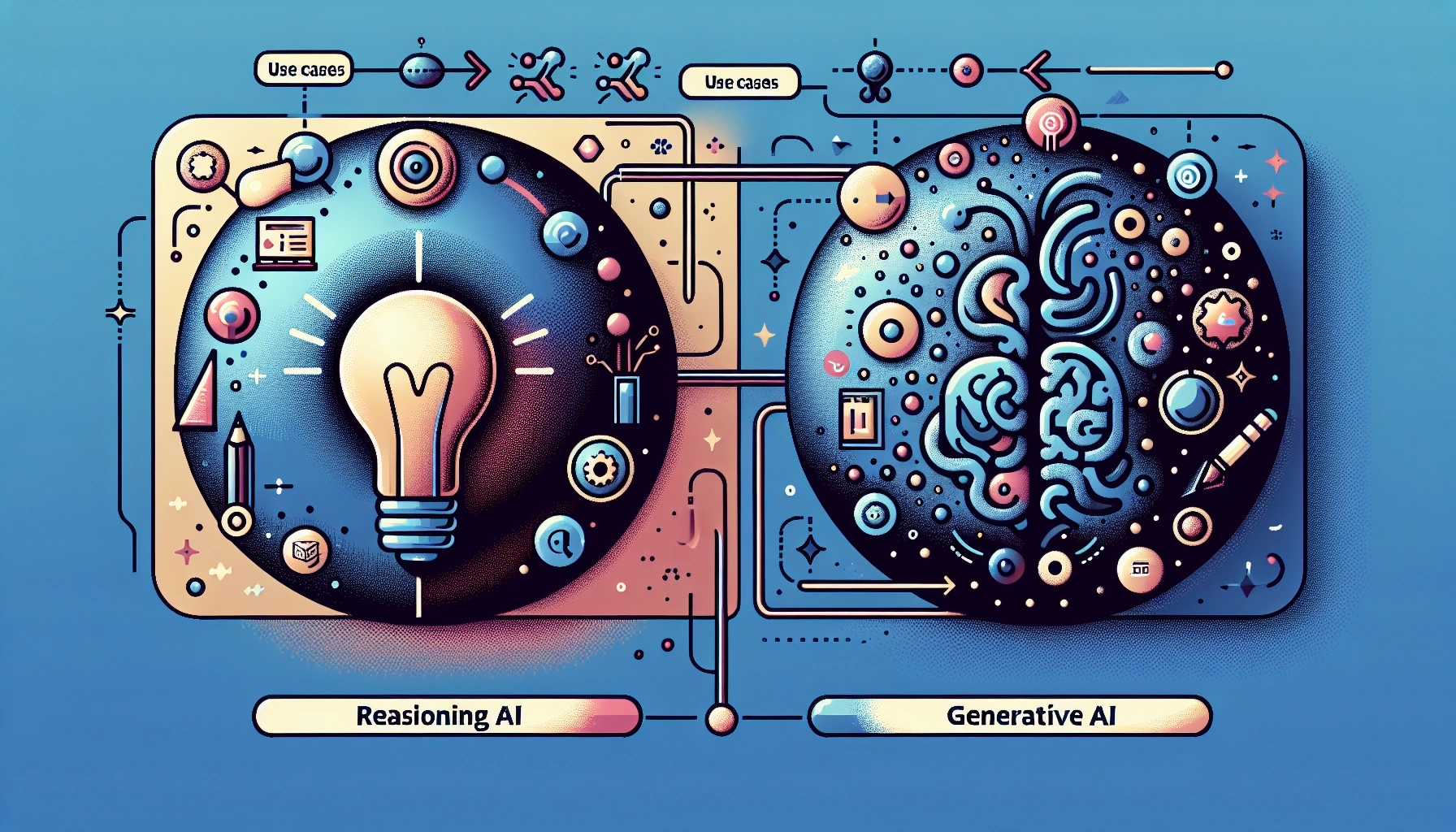
What is Reasoning AI? Reasoning AI focuses on logical inference, causal understanding, and decision-making based on structured knowledge. It uses symbolic representations, knowledge graphs, formal logic, and rule-based systems to derive conclusions from facts. Hybrid models combine neural networks with symbolic reasoning to improve explainability and robustness. Typical features include explicit chains of thought, interpretable steps, constraint handling, and the ability to perform multi-hop inferences across linked data.
What is Generative AI? Generative AI produces novel content — text, images, audio, and code — by learning statistical patterns from large datasets. Transformer-based models, diffusion models, and autoregressive architectures dominate this space. Strengths include fluent language generation, realistic image synthesis, and rapid content creation. Limitations involve hallucinations, lack of grounded factuality, and potential ethical concerns such as copyright and biased outputs.
Key Differences Purpose and Output: Reasoning AI aims to justify decisions and ensure correctness; outputs are structured explanations or logical conclusions. Generative AI prioritizes plausibility and creativity; outputs are often unstructured content designed to mimic human expression. Explainability: Reasoning systems natively provide traceable steps; generative models require auxiliary methods like attention inspection or chain-of-thought prompts to approximate transparency. Data Requirements: Reasoning AI performs well with curated knowledge bases, ontologies, and symbolic rules. Generative AI needs large, diverse corpora for statistical learning. Error Modes: Reasoning AI fails when rules or knowledge are incomplete or inconsistent. Generative AI fails by producing fluent but factually incorrect results (hallucinations). Latency and Efficiency: Reasoning may be computationally intensive for large logical searches but can be optimized with pruning and heuristics. Generative models require heavy pretraining but can be hashed out quickly at inference through optimized serving.
Use Cases for Reasoning AI Legal analysis: Automating statute interpretation, precedent mapping, and compliance checking with traceable arguments. Medical diagnosis support: Integrating symptoms, lab results, and treatment guidelines to recommend evidence-based care paths while documenting rationale. Scientific discovery: Hypothesis generation and verification using causal models and constraint solvers. Knowledge management: Building queryable knowledge graphs that enable accurate multi-step answers across corporate data. Robotics and autonomous systems: Planning and safety verification using formal methods and logical constraints.
Use Cases for Generative AI Content creation: Automated copywriting, marketing assets, and draft reports for rapid ideation. Creative arts: Image synthesis, music composition, and narrative generation for entertainment and media pipelines. Software development: Code generation, test creation, and documentation from natural language prompts. Data augmentation: Synthesizing training examples to improve downstream model performance. Conversational interfaces: Chatbots and virtual assistants providing fluent, context-aware interactions.
Hybrid Approaches Combining reasoning and generative techniques addresses complementary weaknesses. Examples include retrieval-augmented generation (RAG), where a knowledge base supplies factual context and…