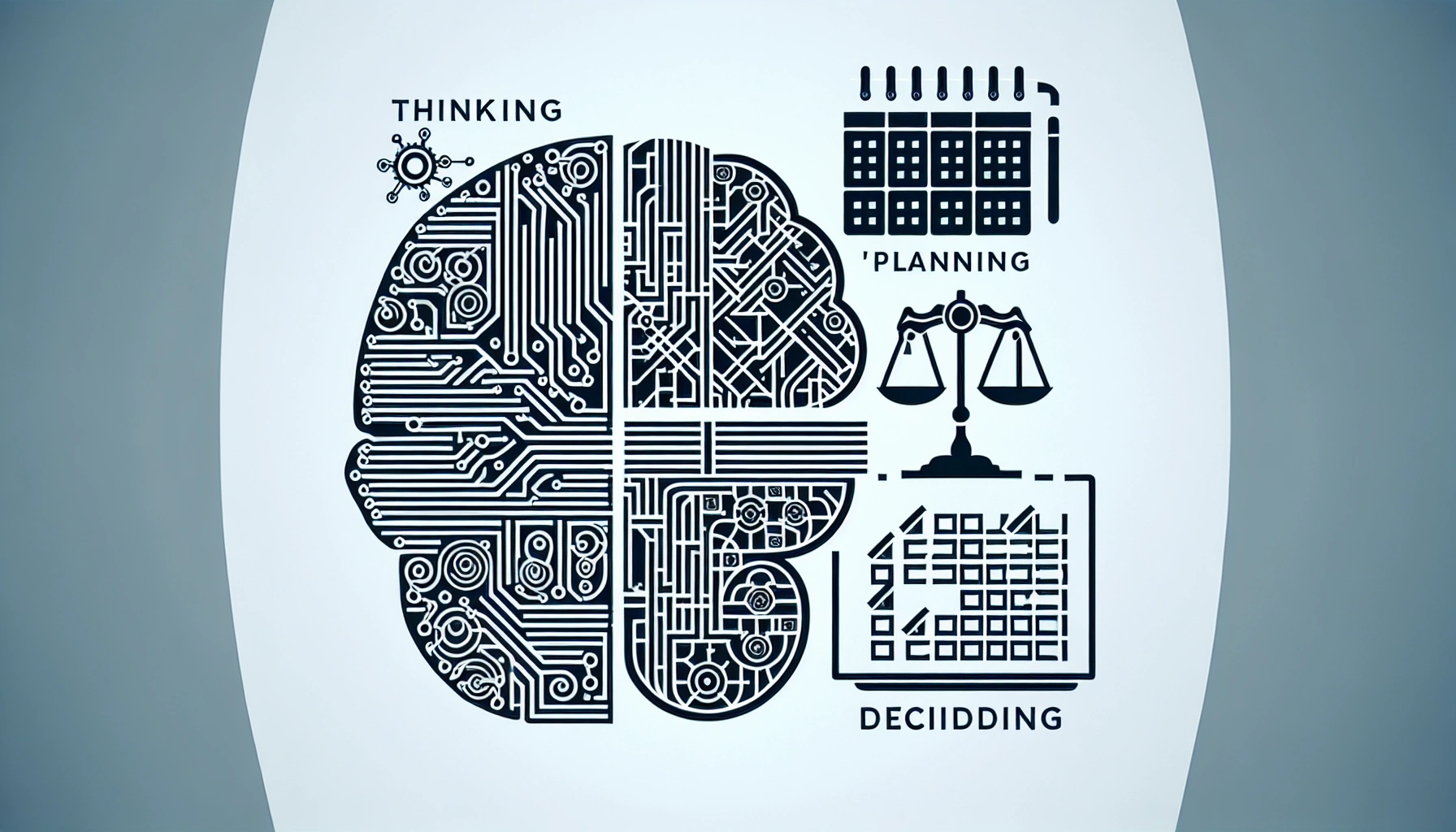
What “Reasoning” Means in AI Systems
Reasoning AI systems are designed to transform information into justified actions. Instead of only mapping inputs to outputs (as many pattern-recognition models do), a reasoning system aims to: represent knowledge, infer new facts, evaluate alternatives, and choose actions that satisfy goals under constraints. In practical terms, this includes producing stepwise solutions, making multi-hop connections across documents, and selecting plans that minimize cost or risk.
Modern reasoning AI often combines machine learning with explicit decision procedures. A single application—like an agent that books travel—may use a language model to interpret requests, a planner to sequence tasks, and a verifier to confirm that the itinerary obeys constraints (budget, dates, layovers). This hybrid approach is common because “thinking” in software usually requires both flexible understanding and precise computation.
Core Building Blocks: Representation, Inference, and Control
Reasoning systems can be explained through three components:
- Representation: How the system stores what it knows (facts, rules, graphs, embeddings, or memories).
- Inference: How it derives new information (logical deduction, probabilistic inference, retrieval, simulation).
- Control: How it decides what to do next (search strategy, planning algorithm, policy, or heuristic).
A system that answers legal questions might represent statutes as text plus citations, infer by retrieving relevant passages and applying rules, and control its process by checking whether it has enough evidence before generating an answer.
Symbolic Reasoning vs. Neural Reasoning (and Why Hybrids Win)
Symbolic AI uses explicit symbols and rules: if-then logic, ontologies, and knowledge bases. It excels at interpretability and strict constraint satisfaction, but struggles with ambiguity and noisy language.
Neural AI (deep learning, including large language models) learns patterns from data. It handles messy inputs well and generalizes across tasks, but may be brittle with exact logic, arithmetic, or long-horizon consistency.
Neuro-symbolic and hybrid reasoning combine them: neural models interpret and propose; symbolic modules verify and enforce constraints. For example, a neural model can draft a plan while a constraint solver ensures the plan meets scheduling rules. This pairing is a major trend in enterprise AI because it reduces errors while keeping flexibility.
How Reasoning AI “Thinks”: Internal Steps Without Human-Like Consciousness
Reasoning AI does not “think” like a person, but it can perform structured computation that resembles deliberation. Typical internal operations include:
- Decomposing a goal into subgoals: Break “reduce churn” into “identify at-risk users,” “predict drivers,” and “choose interventions.”
- Maintaining intermediate state: Keep track of which facts have been established, what remains unknown, and what assumptions were made.
- Iterative refinement: Generate candidate answers or actions, critique them, and revise based on constraints or retrieved evidence.
- Self-checking and verification: Validate numerical results, confirm sources, or run unit tests on generated code.
In practice, these steps are implemented with orchestrators, tool calls, and checkpoints, not with a single monolithic model output.
Planning: Turning Goals Into Sequences of Actions
Planning is where reasoning becomes operational. A planning-capable AI system must select actions that lead from the current state to a desired state. Common approaches include:
- Classical planning: State/action models (e.g., STRIPS-like formulations) and search through possible action sequences.
- Hierarchical planning: High-level tasks broken into reusable subplans (often called HTN planning).
- Probabilistic planning: Plans optimized under uncertainty, balancing expected reward and risk.
- LLM-based planning: Language models propose plans in natural language, then tools validate feasibility.
A reliable agent often uses a loop: propose plan → estimate cost/feasibility → execute step → observe outcome → replan if the world differs from assumptions.
Decision-Making Under Uncertainty: Beliefs, Probabilities, and Utility
Many real-world environments are partially observable. Reasoning AI must distinguish between what is known, likely, and unknown. Systems handle uncertainty using:
- Bayesian inference: Update beliefs as new evidence arrives.
- Confidence estimation: Track reliability of retrieved sources or model outputs.
- Utility functions: Choose actions that maximize expected value, not just immediate success.
- Risk constraints: Enforce guardrails, such as “never expose personal data” or “avoid high-volatility trades.”
For example, a medical triage assistant may recommend follow-up questions when uncertainty is high, rather than committing to a single diagnosis.
Search and Optimization: The Engine Behind Many “Smart” Choices
Reasoning frequently reduces to searching through possibilities. The system may search:
- In a graph of states (planning and routing)
- In a space of solutions (scheduling, assignment, portfolio selection)
- In a space of proofs (logic and theorem proving)
- In a space of texts (retrieval-augmented reasoning)
Algorithms like A*, beam search, Monte Carlo tree search, and constraint programming help prune the space. Heuristics—learned or hand-designed—guide the system toward promising options quickly, which is crucial for SEO-relevant real-time applications like customer support automation.
Tool Use and Grounding: Connecting Reasoning to Reality
A key capability of advanced reasoning AI systems is tool use, where the model calls external functions to get grounded results:
- Databases and search engines for up-to-date facts
- Calculators and code interpreters for exact math
- Compilers and test suites for software correctness
- Simulators for robotics and operations research
- APIs for booking, inventory, billing, and CRM
Tool outputs serve as constraints and evidence. This reduces hallucinations and turns the system into a decision pipeline: interpret request → retrieve data → compute → validate → respond.
Memory and Context Management: Short-Term vs. Long-Term Reasoning
Reasoning quality depends on what the system can remember:
- Working memory: Temporary context for the current task (notes, intermediate results, variables).
- Long-term memory: Persistent knowledge about users, processes, or prior decisions, stored in databases or vector indexes.
- Episodic logs: Trace of actions taken, enabling audits and rollback.
Good context management prevents repeated questions, supports multi-step workflows, and enables personalization—while requiring strict privacy controls and data minimization.
Verification, Guardrails, and Reliability Engineering
Reasoning AI systems must be engineered for correctness, especially in regulated domains. Common reliability techniques include:
- Constraint checking: Hard rules that outputs must satisfy (format, policy, legal requirements).
- Red teaming and adversarial testing: Stress tests for prompt injection, jailbreaks, and deception.
- Multi-model cross-checks: Independent generation and comparison to detect inconsistencies.
- Provenance tracking: Attach sources, citations, and tool results to claims.
- Human-in-the-loop review: Escalate high-impact decisions to experts.
These methods shift AI from “clever text generator” toward “dependable reasoning system.”
Real-World Examples of Reasoning AI Systems
- Customer support agents: Diagnose issues, plan troubleshooting steps, and decide when to escalate.
- Enterprise analytics copilots: Translate questions into queries, test hypotheses, and choose visualizations.
- Autonomous IT operations: Detect incidents, infer root cause, execute runbooks, and verify recovery.
- Robotics and logistics: Plan routes, schedule tasks, and replan under delays or obstacles.
- Compliance assistants: Map regulations to controls, flag gaps, and justify decisions with references.
Each example depends on the same core loop: represent → infer → plan → act → observe → revise.
Key Limitations and Failure Modes to Understand
Even well-designed reasoning AI can fail due to:
- Mis-specified objectives: Optimizing the wrong metric yields harmful decisions.
- Distribution shifts: A plan learned in one context breaks in another.
- Tool or data errors: Grounding is only as good as the sources.
- Overconfidence: High fluency can mask uncertainty.
- Long-horizon drift: Multi-step tasks accumulate small errors.
Mitigations include conservative policies, continuous monitoring, calibrated uncertainty, and automated regression tests on representative workflows.
SEO-Driven Takeaways for Teams Building Reasoning AI
To build reasoning AI systems that think, plan, and decide effectively, focus on: explicit goal and constraint modeling, strong retrieval and tool grounding, robust planning loops with replanning, memory architecture that supports context without leaking data, and verification layers that enforce correctness. This stack yields AI that is both capable and accountable in production environments.