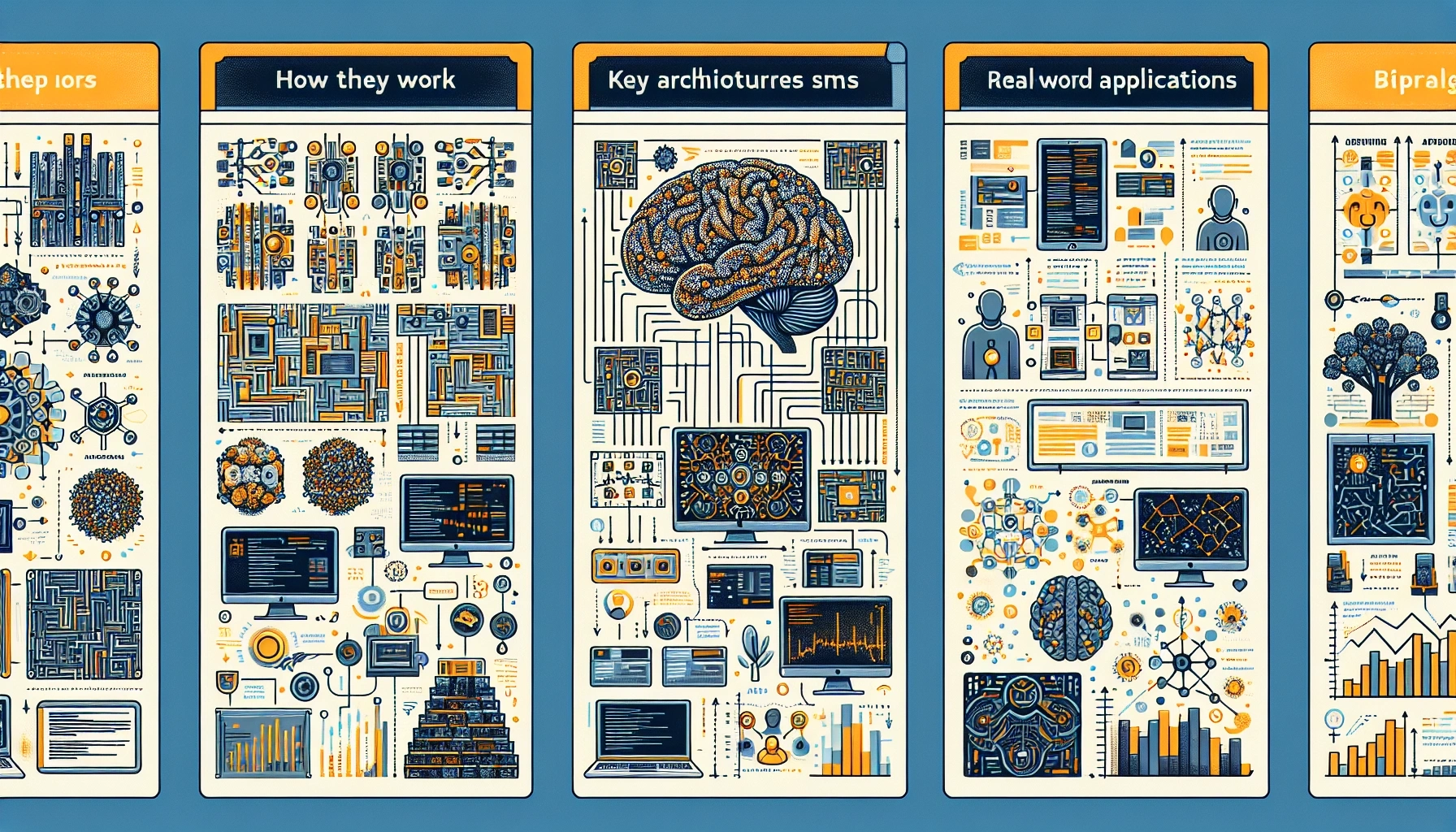
Reasoning AI systems are designed to solve problems that require structured thinking, multi-step inference, and decision-making under constraints. Unlike pattern-matching models that primarily map inputs to outputs, reasoning-oriented systems combine representations of knowledge with mechanisms that manipulate those representations to derive new facts, choose actions, or justify outcomes. In practice, modern “reasoning AI” often blends symbolic logic, probabilistic inference, search, and neural networks to achieve robust performance across ambiguous, real-world environments.
Core components typically include a knowledge representation layer, an inference or planning engine, and a learning subsystem. Knowledge representation defines how facts, rules, relationships, and uncertainty are encoded—using graphs, ontologies, predicates, embeddings, or hybrid forms. The inference engine applies transformations to that knowledge: logical deduction (e.g., modus ponens), induction (generalizing from examples), abduction (inferring the best explanation), constraint propagation, or probabilistic updates. Learning improves representations and heuristics over time by fitting parameters from data, refining rules, or updating belief states based on feedback.
Symbolic reasoning remains central where correctness and interpretability matter. Rule-based expert systems represent domain expertise as IF–THEN rules and use forward chaining (data-driven) or backward chaining (goal-driven) to derive conclusions. Description logics and ontology reasoners support taxonomies, subsumption, and consistency checking, enabling machine-understandable domain models in healthcare, finance, and enterprise knowledge management. Constraint satisfaction and SAT/SMT solving treat reasoning as a satisfiability problem: variables must satisfy logical constraints, making these methods powerful for scheduling, verification, and configuration tasks.
Probabilistic reasoning addresses uncertainty and noise. Bayesian networks represent conditional dependencies among variables and use belief propagation or sampling to compute posterior probabilities. Markov logic networks and probabilistic programming merge logical structure with probability, allowing systems to reason with soft rules—useful in information extraction, fraud detection, and sensor fusion. Decision-theoretic frameworks extend inference to action selection by maximizing expected utility, often implemented with influence diagrams or partially observable Markov decision processes (POMDPs) when state is hidden.
Search and planning are practical engines of reasoning. Classical planners represent actions with preconditions and effects, then search for sequences that achieve goals, using heuristics to manage combinatorial complexity. Monte Carlo Tree Search (MCTS) estimates action values via simulated rollouts and has proven effective in game playing and complex control problems. Modern heuristic search (A, IDA, best-first) remains essential in robotics navigation, route optimization, and automated troubleshooting, especially when combined with learned heuristics that approximate expensive evaluation functions.
Neural approaches add flexible perception and scalable generalization. Transformer-based models can perform multi-step inference by leveraging large-scale pretraining, but reliable reasoning often improves when models are grounded in explicit structures or tools. Retrieval-augmented generation (RAG) fetches relevant documents or database entries, reducing hallucination and enabling evidence-based answers. Tool-using agents call external functions—calculators, solvers, web APIs, knowledge graphs—and then integrate outputs into a coherent plan. Neuro-symbolic architectures connect neural embeddings with symbolic constraints, enabling models to learn from data while respecting rules, ontologies, or program semantics.
Key architectures for reasoning AI systems often follow recurring patterns. Pipeline architectures separate stages: perception or ingestion, knowledge extraction, reasoning, and action. Blackboard systems maintain a shared workspace where multiple specialized modules contribute partial solutions, coordinating through a control strategy—useful in diagnostic reasoning and complex monitoring. Agent architectures implement a perception–belief–desire–intention loop, maintaining state, generating candidate plans, and revising commitments when new information arrives. In enterprise settings, knowledge graph architectures represent entities and relations in a graph database, paired with graph algorithms and rule engines to answer multi-hop queries and support explainable recommendations.
Another major pattern is “planner + executor.” A planner decomposes goals into steps, while an executor performs steps, observes outcomes, and triggers replanning if conditions change. This is common in robotic manipulation, IT automation, and workflow orchestration. Similarly, “retriever + reasoner” combines semantic search with structured inference: retrieve supporting evidence, rank it, apply rules or probabilistic inference, and produce a decision with citations and confidence estimates.
Evaluation of reasoning AI systems emphasizes more than accuracy. Key metrics include consistency (no contradictions across answers), faithfulness (outputs supported by evidence), robustness (handling adversarial or out-of-distribution inputs), calibration (confidence reflects true correctness), and latency/cost (time and compute per query). For safety-critical domains, formal verification and traceable audit logs matter: the system should provide reasoning traces, rule firings, or probabilistic explanations that humans can inspect. Continuous monitoring is also essential because data drift can silently degrade learned heuristics and retrieval quality.
Real-world applications are expanding quickly as organizations operationalize reasoning capabilities. In healthcare, clinical decision support systems combine patient data, guidelines encoded as rules, and probabilistic risk models to recommend tests, flag drug–drug interactions, and triage cases. Knowledge graphs unify labs, imaging findings, and medical ontologies, enabling clinicians to query comorbidities and treatment pathways. In finance, reasoning AI powers anti-money laundering by linking transactions into graphs, applying typology rules, and updating suspicion scores probabilistically; it also supports credit underwriting by enforcing policy constraints while learning risk signals.
In manufacturing and logistics, constraint-based reasoning schedules production lines, allocates inventory, and optimizes routes under capacity, labor, and delivery windows. Digital twins use planning and inference to test interventions before executing them on physical assets. Predictive maintenance systems reason over sensor streams, failure modes, and causal graphs to identify likely root causes and recommend corrective actions. In cybersecurity, reasoning systems correlate alerts across endpoints, identities, and network flows, then generate incident hypotheses and response playbooks; graph-based inference helps uncover lateral movement and hidden attacker paths.
Customer support and enterprise operations increasingly use tool-augmented reasoning agents. These systems retrieve policy documents, interpret tickets, run diagnostics, and propose stepwise resolutions while logging rationale. In legal and compliance workflows, reasoning AI helps map regulations to internal controls, detect policy conflicts, and answer audit questions with evidence trails. In education, intelligent tutoring systems model student knowledge states and reason about misconceptions, selecting next problems and explanations that maximize learning gains.
Autonomous systems rely heavily on reasoning for safety and adaptability. Robots combine perception with planning to navigate dynamic environments, avoid obstacles, and manipulate objects under constraints. Self-driving stacks use probabilistic prediction of other agents, decision-theoretic planning, and rule-based safety constraints to reduce risk. In energy and utilities, reasoning AI optimizes grid operations, forecasts demand, and schedules storage while enforcing reliability constraints and regulatory rules.
High-performing reasoning AI systems are rarely purely symbolic or purely neural; they are engineered hybrids that select the right inference style for the task: logic for hard constraints, probability for uncertainty, search for combinatorial planning, and neural learning for perception and heuristics. The most effective deployments treat reasoning as an end-to-end system problem—data quality, knowledge maintenance, tooling, evaluation, and governance—so that models do not merely produce answers, but produce decisions that are grounded, auditable, and operationally reliable.